 St. Petersburg Terrazzo Restoration
 Terrazzo Restoration in St. Petersburg
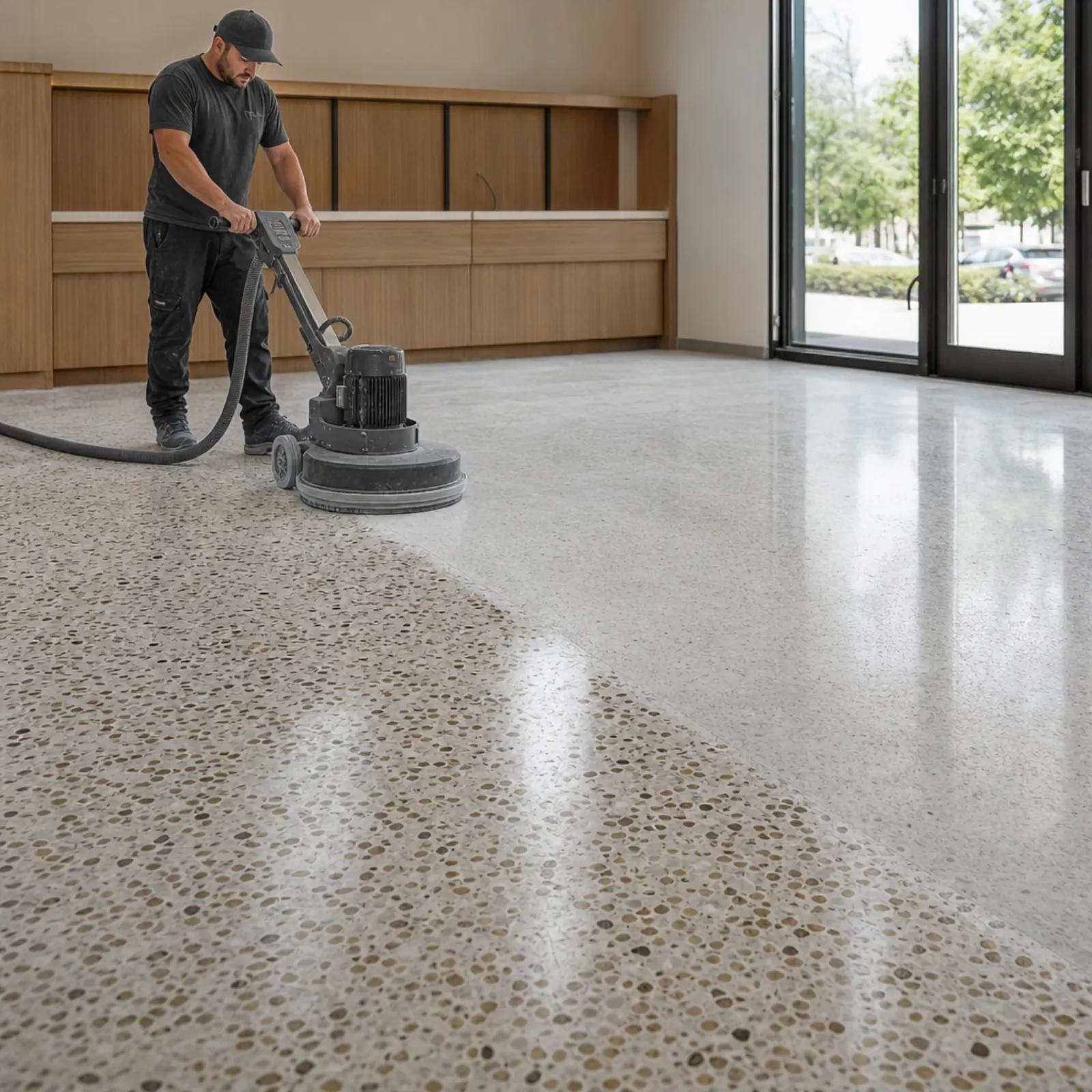
Full terrazzo restoration in St. Petersburg takes a floor that has spent forty years under carpet, vinyl, or tile and returns it to the ground-and-polished marble surface the house was built with. The grind and polish runs $4 to $8 per square foot, removal adds $2 to $5 per square foot, repairs are $75 to $250 per patch, and most 1,200 to 1,800 square foot mid-century block homes finish between $3,000 and $9,000. Send a photo of a corner with the carpet pulled back and we can give you a real range from it.
This page is the whole sequence. If you already know your floor is exposed and just needs polishing, the grinding and polishing page is the shorter read. If you only have a crack or a hole, start at crack and hole repair.
What you probably have
If your house is one of the concrete block ranches that St. Petersburg built while its population went from 96,738 in 1950 to 216,159 in 1970, the floor under your carpet is very likely cement terrazzo. The University of Florida’s survey of Florida’s mid-century single-family housing quotes a period trade description of the typical Florida house as “built on slabs, terrazzo or resilient tile floors, cement tile roofs, prefabricated roof trusses, and 99 percent concrete block,” and it notes that block gave way to wood framing in the 1970s, which is roughly when cement terrazzo stopped being the default too.
What that floor is: marble chips, usually a quarter inch or smaller in the 1950s and larger in some 1960s floors, set in a Portland cement matrix tinted white, gray, or sometimes pink or green, poured over the slab, divided into panels by brass or zinc strips, ground flat on site, and polished. The National Terrazzo and Mosaic Association’s history of the divider strip credits Louis Del Turco of Harrington, New Jersey with the 1921 U.S. patent for metal dividers “to prevent or at least localize cracks,” and notes that brass was the standard with zinc used for looks, typically as a two-piece strip over galvanized steel until around 2000.
The five stages
1. Expose and assess
Carpet, pad, tack strips, vinyl, laminate, or tile come up, along with as much adhesive as can be scraped. This is when the floor tells the truth. A good contractor looks at chip size and color, the amount and type of glue, cracks, holes, previous coatings, and slab moisture. Under carpet the usual finds are tack-strip nail holes every few inches around every room, rust rings around them, and dye bleed from rubber pad. Under tile the terrazzo is pitted where the tile setter scarified it, which is normal and repairable. Under 1970s vinyl there is often a black cutback adhesive that takes extra metal-bond passes. The removal page has the details and the per-foot prices.
2. Repair
Holes and cracks are cleaned to sound material and filled with matched marble chips in a tinted cement or epoxy matrix. The NTMA’s restoration guide specification, revised July 2021, treats hairline cracks under 1/32 inch as a simple resin fill and calls for aggregate in the fill when a crack is wider than a quarter inch; where a panel is too damaged to patch, it is replaced from divider strip to divider strip, or with a saw-tooth joint if the repair cannot reach a strip. Missing or bent divider strips are reset or replaced in matching metal. Patches cure before any grinding starts, because a soft patch smears under the machine.
3. Grind
A planetary grinder with metal-bond diamond segments, starting around 30/40 grit and moving to 80 grit, cuts the floor flat and removes glue, stains, coatings, and the dull top layer. The floor is ground wet with vacuum shrouds, which keeps the slurry contained and the dust down. This stage is where a floor that had a 1980s acrylic coating costs more: the film has to come off completely before the stone can be honed, and it tends to hide staining underneath. Edges along walls and in closets are done with hand grinders.
4. Hone and polish
Resin-bond diamonds take over at 100 grit and climb through 200, 400, 800, 1500, and up to 3000 depending on the finish you want. The NTMA’s own guidance describes terrazzo finishes ranging from a standard 120-grit finish to 1500 grit or more with diamond-impregnated pads. A silicate densifier applied partway through hardens the cement matrix so it takes and holds a polish; the NTMA sealer reference guide describes this honing-plus-densification routine as the approach where the shine comes from the abraded stone itself rather than from a sacrificial coating. Matte stops early, satin in the middle, high gloss at the top.
5. Seal
A penetrating sealer, not a film. The NTMA says a penetrating sealer is applied to cement terrazzo for resistance to stains, dirt, and wear, and it warns that wax coats the surface, can yellow and dull, wears quickly, and makes the floor slippery. The slab is moisture-tested before sealing, which matters on this peninsula. Care afterward is a pH-neutral cleaner and nothing acidic; the NTMA care guide says no vinegar, bleach, ammonia, or degreasers. The sealing page covers the routine.
What restoration cannot do
Honesty is the whole difference between a good terrazzo company and a coating company. Three limits:
- Deep stains. Pet urine and old oil that soaked into the cement matrix over decades sometimes lighten and sometimes stay. The NTMA restoration specification states that all staining in existing terrazzo may not be possible to remove. Rust and carpet dye, by contrast, are shallow and almost always grind out. The stain page sorts them.
- Invisible patches. A patch matched by chip color, chip size, and matrix tint looks right from standing height and is visible up close. Marble is a mined product and the NTMA notes that color matching existing aggregate may not be exact. Ask for a mock-up patch before the rest.
- Structural cracks. A crack that follows slab movement will move again. Restoration fills it and grinds it flush; it does not stop the slab. If a crack is active, you should be told so, and it should be filled with a material that can flex.
Neighborhoods where this is the standard job
Disston Heights, where a local neighborhood guide puts 93 percent of the homes in the 1950s and 1960s on 30 to 60 feet of elevation and dry Zone X ground. Meadowlawn and Allendale on the higher interior blocks north of downtown. Jungle Terrace, described in the St. Pete Home Guide as late-1940s to mid-1970s block homes with terrazzo floors and jalousie windows. Shore Acres, Snell Isle, Broadwater, Bahama Shores, and Pinellas Point on the water, where the same floors sit over wetter slabs and where the September 2024 surge from Hurricane Helene left a lot of terrazzo exposed. And the 1950s blocks of Gulfport, Pinellas Park, and Largo, which grew on the same block-and-slab formula.
Pricing
| Stage | Range |
|---|---|
| Removal (carpet/glue or tile/thinset) | $2 to $5 per sq ft |
| Repair | $75 to $250 per patch, rooms of nail holes by the room |
| Grind, hone, polish, densify, seal | $4 to $8 per sq ft |
| Whole house, 1,200 to 1,800 sq ft | $3,000 to $9,000 |
| Minimum | $600 to $1,000 |
What moves the number is on the pricing page: chip size, what is on the floor, previous coatings, damage count, and the sheen. If you want the range before you send anything, the cost calculators run the same arithmetic on the page with no email and no signup. Send the photo, get the range, and get a plain answer about which spots will disappear and which will only fade.
Frequently Asked Questions
What does full terrazzo restoration include?
Everything from the carpet down: removing the floor covering and adhesive, repairing holes and cracks with matched chips, grinding with metal-bond diamonds to flatten and strip the old surface, honing and polishing with resin-bond diamonds to the sheen you want, densifying, and sealing with a penetrating sealer. It is priced at $4 to $8 per square foot for the grind and polish plus removal and repair line items, and most whole houses land between $3,000 and $9,000.
How long does a whole-house restoration take?
Several days for a typical 1,200 to 1,800 square foot mid-century home, longer if there is tile to remove or many patches to cure. Rooms are done in phases so you can stay in the house. An empty house is the fastest and cheapest version of the job.
Will the floor look new?
It will look like a well-kept 1958 terrazzo floor, which is the point. Expect a flat, even polish with the chip pattern crisp and the divider strips bright. Also expect that a deep stain may only lighten and that a patch is visible up close; the NTMA's restoration guide says both of those things, and this page agrees.
Is the terrazzo thick enough to grind?
Mid-century cement terrazzo was poured roughly half an inch to three-quarters of an inch thick over the slab, and restoration removes only a thin layer, well under a sixteenth of an inch in most cases. A floor can be restored more than once in its life. The exception is a floor that was ground aggressively before, which shows in how much strip is standing proud.
Do you restore terrazzo after flood damage?
Yes, and it is one of the best reasons to own it. After Hurricane Helene's surge in September 2024, floors in Shore Acres, Snell Isle, and Gulfport that had been under carpet for decades were exposed when the wet flooring was hauled out. The terrazzo underneath is restorable; the slab is moisture-tested before sealing and a penetrating sealer is used so it can keep breathing.
More terrazzo services
Areas we serve
- St. Petersburg, FL
- Terrazzo Restoration in Belleair, Florida
- Terrazzo Restoration in Clearwater, Florida
- Terrazzo Restoration in Dunedin, Florida
- Terrazzo Restoration in Gulfport, Florida
- Terrazzo Restoration in Kenneth City, Florida
- Terrazzo Restoration in Largo, Florida
- Terrazzo Restoration in Pinellas Park, Florida
- Terrazzo Restoration in Safety Harbor, Florida
- Terrazzo Restoration in Seminole, Florida
- Terrazzo Restoration in St. Pete Beach, Florida
- Terrazzo Restoration in Treasure Island, Florida