 St. Petersburg Terrazzo Restoration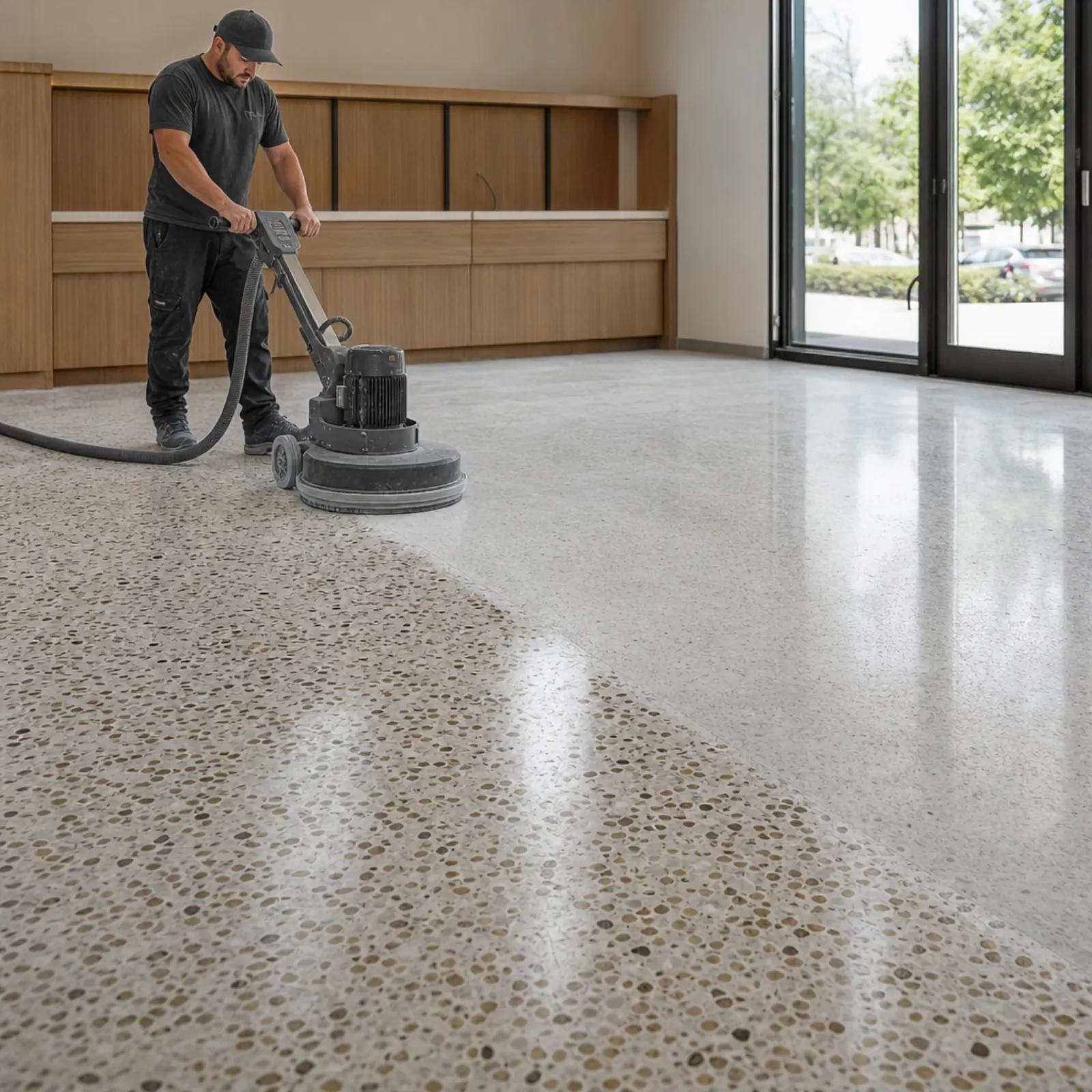
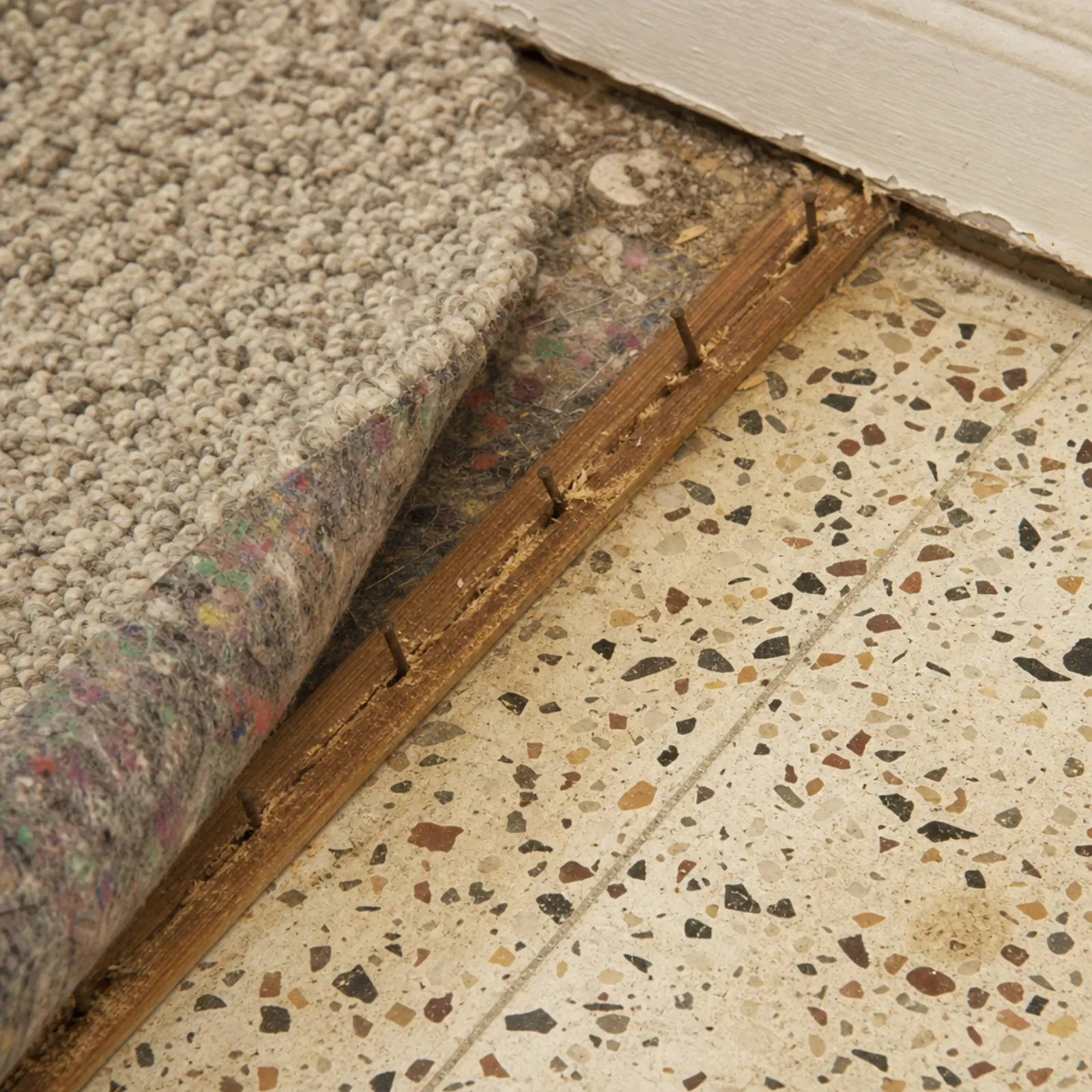
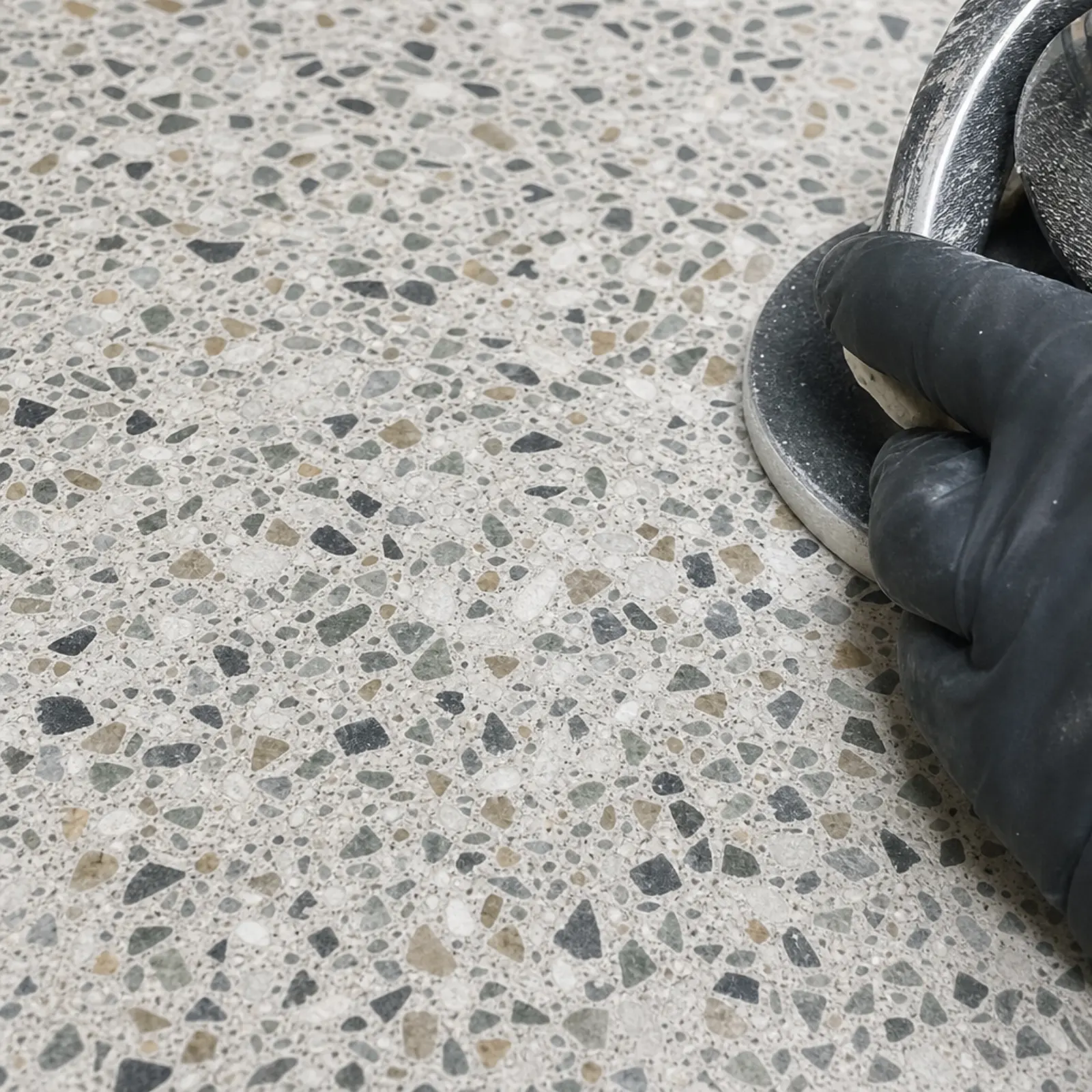
St. Petersburg Terrazzo Restoration grinds, hones, repairs, and polishes the original terrazzo floors in 1950s and 1960s concrete block homes across St. Petersburg and Pinellas County. Grind and polish restoration runs $4 to $8 per square foot, carpet, tile, and glue removal adds $2 to $5 per square foot, and hole and crack repair runs $75 to $250 per patch; most whole-house jobs on a 1,200 to 1,800 square foot mid-century home land between $3,000 and $9,000. Send a photo of a corner under the carpet and we can give you a real number, with no coatings, no wax, and no sales walk-through.
There is more mid-century terrazzo per square mile in Pinellas County than almost anywhere in the country, and most of it is buried under carpet, vinyl, laminate, and tile laid down in the 1980s and 1990s. Bringing it back is not a cosmetic buff. It is a stone-restoration job done with planetary diamond grinders, and the difference between a floor that stays beautiful for another fifty years and one that yellows in eighteen months is whether the crew ground the stone or painted it.
What the work covers
- Terrazzo restoration: the full sequence, expose, repair, grind, hone, polish, seal, for a floor that has been covered or neglected for decades.
- Terrazzo grinding and polishing: metal-bond diamonds to cut through glue and the tired surface, resin-bond diamonds up through the grits to a matte, satin, or high-gloss finish that comes from the stone.
- Crack and hole repair: control-joint cracks, plumbing holes, wall-relocation trenches, and thousands of tack-strip holes filled with matched marble chips in a tinted matrix and ground flush.
- Carpet, tile, and glue removal: carpet, pad, tack strip, tile, thinset, and forty years of adhesive stripped without gouging the terrazzo underneath.
- Stain and rust removal: rust rings from tack-strip nails, dye bleed from carpet pad, pet stains, and old oil pulled from the stone with honest talk about which ones will only lighten.
- Sealing and maintenance: penetrating sealers and a pH-neutral care routine that keeps the polish without wax buildup.
Why St. Petersburg is a terrazzo town
The numbers explain it. St. Petersburg’s population went from 96,738 in 1950 to 181,298 in 1960 and 216,159 in 1970, according to the U.S. Census figures on the city’s Wikipedia page, and Pinellas County as a whole went from 159,249 to 522,329 people over the same twenty years. Nearly all of that growth was housed in single-story concrete block ranch homes on slab-on-grade foundations. The University of Florida’s statewide survey of postwar single-family housing, Florida’s Single Family Housing at Mid-Twentieth Century (1945-1975), quotes the trade magazine House and Home describing the typical Florida house of the period as “built on slabs, terrazzo or resilient tile floors, cement tile roofs, prefabricated roof trusses, and 99 percent concrete block.” That is the house on every block of Disston Heights, Meadowlawn, Jungle Terrace, Shore Acres, and Pinellas Point.
The same survey notes that by the 1970s block was being replaced with wood framing, and the cement-terrazzo trade shifted toward thin epoxy systems around the same time. So the window is real: a St. Pete block home built between roughly 1950 and 1972 almost certainly has a half-inch to three-quarter-inch cement terrazzo topping poured over the slab, divided into panels by brass or zinc strips, and ground flat on site by a crew with a rotary machine. A house built after about 1975 usually does not.
Where it lives, neighborhood by neighborhood:
- Disston Heights: a neighborhood guide from Ben Laube Homes puts 93 percent of its homes in the 1950s and 1960s, concrete block ranches of 1,200 to 1,700 square feet, on some of the highest ground in the county at 30 to 60 feet above sea level and entirely in FEMA Zone X. Dry slabs, clean grinding, and a lot of gray-and-white small-chip floors. Preserve the ‘Burg counts the 1960s ranch where Jack Kerouac lived among its Disston Heights landmarks.
- Meadowlawn and Allendale: Meadowlawn is 1950s and 1960s concrete block ranch construction of 1,000 to 1,600 square feet on higher interior ground in the 33703 ZIP, per the St. Pete Home Guide; Allendale’s roughly 1,800 homes were developed mostly in the 1940s through 1960s between 22nd and 38th Avenues North and sit mostly in low-risk Zone X.
- Jungle Terrace and Jungle Prada: the St. Pete Home Guide describes the housing between 22nd and 54th Avenues North and west of 66th Street as late-1940s to mid-1970s concrete block with terrazzo floors, jalousie windows, and wide carports. The Jungle Prada Site at the neighborhood’s western edge, a Tocobaga mound complex occupied from about 1000 to 1600 CE, was added to the National Register of Historic Places on February 4, 2003.
- Shore Acres and Snell Isle: Shore Acres was platted in the 1920s and built out mostly in the 1950s through 1970s, about 2,200 homes at 2 to 7 feet above sea level and substantially in Zone AE. Snell Isle opened in October 1925 with only 39 of its 275 acres above the high-tide line, per its Wikipedia entry, and the surviving mid-century houses there share the same slabs and the same water table.
- Pinellas Point, Broadwater, and Bahama Shores: the UF survey traces Pinellas Point’s development from the mid-1920s through the 1970s, first under landowner Ed C. Wright until his death in 1969 and then under Rutenberg Homes, and calls the community potentially eligible for listing as a local or National Register historic district. The 1968 DeGroot Residence there, by Sanford Goldman, who apprenticed under Frank Lloyd Wright at Taliesin in 1957 and 1958, is the survey’s featured St. Petersburg house. Broadwater’s sailboat-access canals run to Tampa Bay with no fixed bridge, and Bahama Shores sits on the bay between Coquina Key and Lake Maggiore. All three are mid-century block ranches, and all three have slabs that see high water.
- Gulfport: grew from 3,702 people in 1950 to 9,730 in 1960, and its 1950s blocks are as terrazzo-dense as anything in St. Pete. More on the Gulfport page.
What is actually under your carpet
After grinding floors in this county, the list of what our crew finds is predictable:
- Carpet glue and pad residue, sometimes two or three generations of it, plus tack strips nailed every few inches around every room. Each nail left a hole and often a rust ring.
- Tile and thinset: every chip of a tile floor comes off the terrazzo with some spalling; a little pitting is normal and gets filled, but the tile crew’s original mortar bed can be surprisingly hard.
- Stains: rust from the tack nails, dye bleed from rubber carpet pad that sat wet after a storm, pet urine that soaked into the cement matrix, old oil at the kitchen and garage thresholds.
- Cracks along control joints and where the slab moved, and holes from plumbing re-routes, removed walls, and floor safes.
- Old coatings: acrylic “terrazzo shine,” urethane, and wax layered on in the 1970s and 1980s, now yellow and peeling.
- Missing or bent divider strips where somebody cut a trench for a drain line.
None of it is a reason to give up on the floor. All of it is a reason to price the job by what is actually on the slab, which is why a photo of a corner matters more than the square footage. If you already know what you are looking at, the problem pages cover each of these symptoms one at a time, with the check you can do yourself and the price attached.
How restoration is done, step by step
- Expose and assess. Carpet, pad, tack strip, tile, and adhesive come up. We look at chip size and color, the thickness of the topping, cracks, previous coatings, and slab moisture before quoting the grind.
- Repair. Holes and cracks are cleaned and filled with matched marble chips in a tinted cement or epoxy matrix; the NTMA restoration guide specifies aggregate in any crack wider than a quarter inch. Divider strips are reset or replaced in matching metal. Repairs cure before grinding.
- Grind. Planetary diamond grinders with metal-bond segments, typically 30/40 through 80 grit, flatten the floor and remove glue, stains, coatings, and the dead top layer. Wet grinding with vacuum shrouds keeps the dust down.
- Hone and polish. Resin-bond diamonds step up from 100 grit through 400, 800, 1500, and as high as 3000 grit depending on the sheen you want. The NTMA notes that terrazzo finishes range from a standard 120-grit finish to 1500 grit or more with diamond-impregnated pads. A densifier hardens the cement matrix along the way.
- Seal. A penetrating (impregnating) sealer, never wax and never a film. Care afterward is a pH-neutral cleaner; the NTMA’s care guide says not to use vinegar, bleach, ammonia, or degreasers on terrazzo.
Honest pricing, published
| Work | Typical range |
|---|---|
| Grind and polish restoration | $4 to $8 per sq ft |
| Carpet, tile, or glue removal | $2 to $5 per sq ft extra |
| Hole and crack repair | $75 to $250 per patch |
| Stain and rust treatment | $150 to $600 per area |
| Sealing only, already restored floor | $1 to $2 per sq ft |
| Whole house, 1,200 to 1,800 sq ft | $3,000 to $9,000 |
| Minimum, single room or repair-only visit | $600 to $1,000 |
Full breakdowns and what moves each number are on the pricing page. Short version: heavy glue, thinset, and old coatings push the grind toward $8; a clean floor that was only ever carpeted sits near $4.
Who does the work
Florida does not license terrazzo restoration as a trade. Section 489.117(4)(a) of the Florida Statutes now bars counties and cities from requiring a local license for “decorative stone, tile, marble, granite, or terrazzo installation,” along with painting and flooring, and the Pinellas County Construction Licensing Board’s May 2024 notice confirms its Tile and Marble Specialty license was eliminated on July 1, 2024. So anyone can call themselves a terrazzo company. What you can check is insurance, equipment, and method. Ask any contractor, us included, whether they grind with diamond tooling and seal with penetrating sealers. We are an independently operated local service, and if the honest answer on your floor is “that stain will only lighten,” you should hear it before the work starts, not after.
Areas covered
The service area covers the whole southern half of the peninsula from St. Petersburg and reaches north on US 19 and Alt 19. Nearby: Gulfport, Pinellas Park, and Seminole. Mid-county: Largo. North county: Clearwater and Dunedin. We work in all of them.
Send a photo of the floor with the carpet pulled back at a closet corner, a shot of the worst spot, and the rough square footage. You get a diagnosis, a number from the published ranges, and a straight answer about what will and will not come out. Questions first? The FAQ and about page cover the rest.