 St. Petersburg Terrazzo Restoration
 Terrazzo Crack and Hole Repair in St. Petersburg
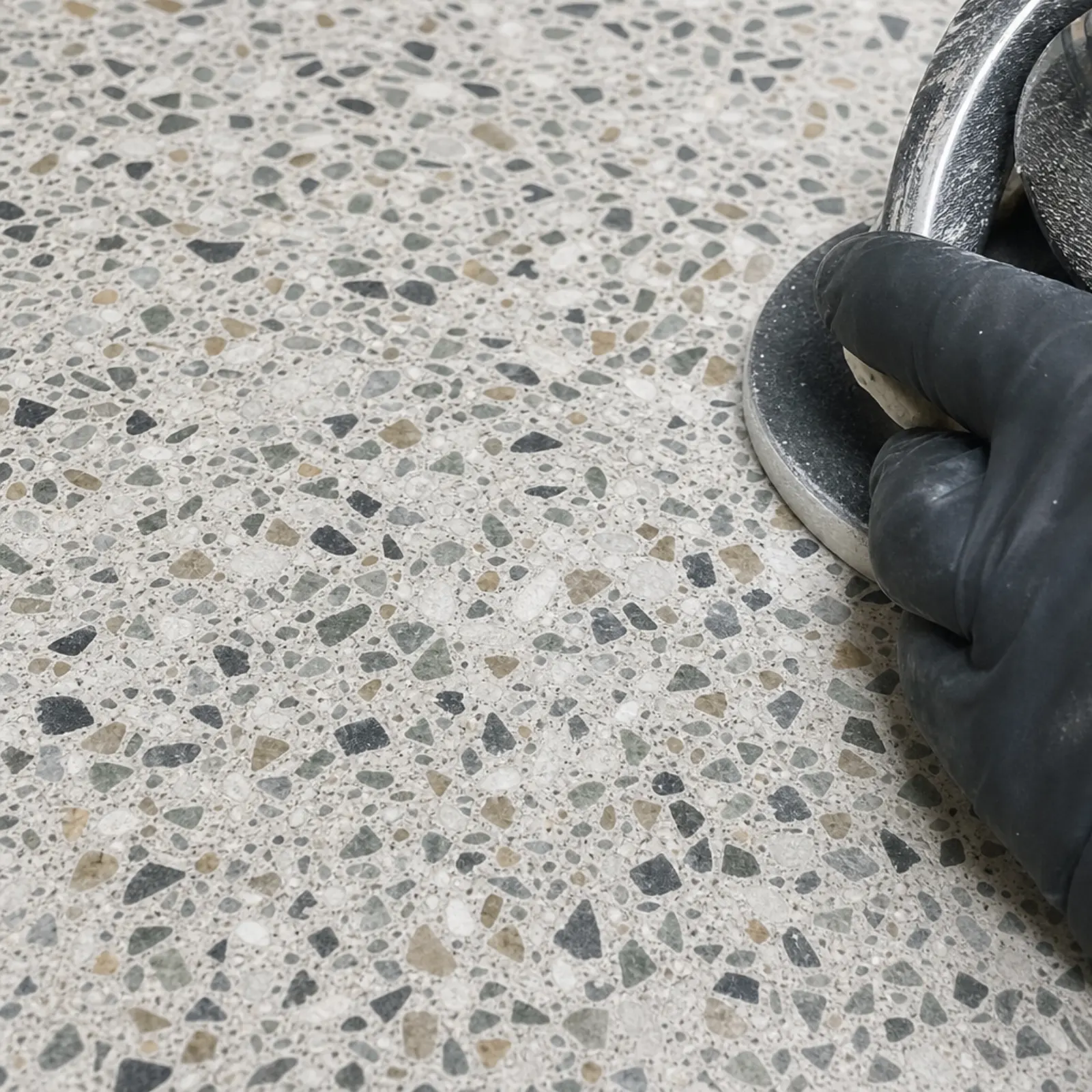
Terrazzo crack and hole repair in St. Petersburg runs $75 to $250 per patch: the damaged area is cut back to sound material, filled with marble chips matched to your floor in a tinted cement or epoxy matrix, cured, and ground flush so it disappears at standing height. Rooms full of tack-strip nail holes are priced by the room, and a repair-only visit carries a $600 to $1,000 minimum. Send a photo of the hole or crack with a coin for scale, which is usually enough for a number.
Almost every mid-century Pinellas floor needs some of this. The house is sixty or seventy years old, plumbing has been re-routed, walls have come out, and the carpet crew of 1987 nailed tack strip around every room. Repair is the second stage of full restoration and it always happens before grinding, because a patch that is not cured smears under the machine.
The damage a St. Petersburg floor collects
- Tack-strip nail holes. Hundreds per room, every couple of inches along every wall, usually with a rust ring. They are shallow and most grind out; the deeper ones get filled.
- Plumbing holes. A round core where a drain or supply line was moved, common in kitchens and baths that were remodeled in the 1970s and 1980s, and in houses where cast iron drain lines under the slab were replaced. The St. Pete Home Guide’s Allendale neighborhood page notes that 1950s and 1960s construction there often still has cast iron drain lines, and replacing them means cutting the floor.
- Wall trenches. A strip of bare slab or rough concrete where a partition wall was removed to open a kitchen. The terrazzo stops at the old wall line on both sides.
- Floor safe and post holes. Square holes from removed safes, jalousie porch enclosures, and carport posts where a carport was converted.
- Chips and spalls at doorways where tile was chiseled off or a threshold was pried up.
- Cracks. Shrinkage cracks from the original pour, cracks along control joints where a divider strip is missing, and cracks that track slab movement.
- Missing or bent divider strips. Cut out for a drain trench or crushed by a tile crew’s scraper.
How a patch is made
- Cut back. Loose and crumbling matrix is removed to sound terrazzo. The NTMA restoration specification calls for replacement areas to run from architectural break to architectural break, usually strip to strip, and where that is not practical, for the joining edge to be cut as a saw-tooth (jagged) edge so the patch line does not read as a straight seam. For a small hole the cut is just a clean, slightly undercut opening.
- Repair the slab. If the hole goes through to bare concrete or the concrete itself is cracked, the substrate is filled first. The NTMA guide specifies filling cracks in the concrete with a hardening epoxy.
- Match the aggregate. Marble chips are selected by color and size to the existing blend. The GSA’s terrazzo repair specification requires aggregate to match the existing “in color and gradation of sizes” and, for saw-tooth joints, calls for irregularly placing chips that match the existing blend across the joint so it feathers. Mid-century St. Petersburg floors run to white, gray, tan, pink, green, and black chips, and the matrix is tinted to the original, which is why a chip of the old floor from a closet is useful.
- Fill. Cement matrix for a large panel that will be ground with the rest of the floor; epoxy for small holes and cracks because it cures faster and bonds to old cement. The NTMA restoration spec lists pigmented epoxy matched to a sample as the standard patching matrix.
- Cure and grind. The patch cures, then it is ground flush along with the rest of the floor in the grinding and polishing passes. A patch that is ground separately from the surrounding floor always shows a halo.
Cracks: the honest version
The NTMA restoration guide classifies hairline cracks as less than 1/32 inch and treats them as a clean-and-fill with resin matched to the existing floor. Anything wider than a quarter inch gets aggregate in the fill so the patch line has chips in it rather than a solid stripe of matrix. That part is straightforward.
The judgment call is whether the crack is moving. Cement terrazzo cracks for two reasons: shrinkage during the original cure, which is what divider strips exist to control, and slab movement afterward. The NTMA’s own history of the divider strip quotes the 1921 Del Turco patent language, “to prevent or at least localize cracks,” and notes that cement terrazzo still calls for strips on roughly a four-by-four-foot grid. A crack that runs where a strip should have been is a shrinkage crack from the pour, stopped moving sixty years ago, and fills cleanly. A crack that runs diagonally across panels, through strips, and lines up with a crack in the block wall is telling you the slab moved, and on this peninsula slabs do move: Shore Acres sits 2 to 7 feet above sea level, Largo’s and Seminole’s listed elevations are a few feet, and the water table is close everywhere. A moving crack gets a flexible fill and the NTMA’s optional isolation membrane approach where an epoxy system is used, and an honest contractor says plainly that it may reopen. What nobody should do is fill it rigid, grind it pretty, and let it split again in a year.
Divider strips
Strips are structural and decorative at once, and they date the floor. The NTMA divider strip history notes brass was the primary early material with zinc used for aesthetic reasons, that two-piece construction with a brass or zinc top on galvanized steel was standard until around 2000, and that strip widths run from an eighth to half an inch. On a repair, a bent strip is straightened or reset; a missing one is replaced in the same metal and width so it grinds and brightens with its neighbors. The GSA specification is explicit that replacements match size, color, sheen, and metal.
What repair cannot promise
A patch is visible up close. Matched chips in a tinted matrix, ground flush, look right from standing height and in most light, and they look like a patch when you crouch over them. The NTMA restoration guide states that color matching existing aggregates may not be exact because they are mined products that change over time, and it recommends a mock-up and a meeting to set expectations before repairs begin. That is the process to ask for: one patch, approved, then the rest.
Some owners choose to make a large repair a feature instead of hiding it: a contrasting panel with new strips where a wall came out, for example. That is an honest option and often looks better than a near-miss color match across a four-foot trench.
Pricing
| Repair | Range |
|---|---|
| Small hole, plumbing core, spall | $75 to $150 |
| Wall trench, panel replacement, strip work | $150 to $250 per patch |
| Room of tack-strip nail holes | By the room |
| Slab crack, flexible fill | $150 to $250 |
| Repair-only visit minimum | $600 to $1,000 |
Repairs done as part of a whole-house restoration are cheaper per patch than a repair-only visit, because the grinder is already on site. The full table is on the pricing page. Our crews repair floors across St. Petersburg and out to Gulfport, Pinellas Park, Largo, Seminole, Clearwater, and Dunedin. Send the photo with a coin in it.
Frequently Asked Questions
How much does terrazzo repair cost?
Hole and crack repair is $75 to $250 per patch. A single plumbing hole is at the low end; a trench where a wall was removed, or a crack that needs a panel cut back to a divider strip, is at the top. A room with hundreds of tack-strip nail holes is priced by the room, and a repair-only visit carries a $600 to $1,000 minimum.
Will the patch be invisible?
No, and anyone who says otherwise is setting you up. A patch is matched by chip color, chip size, and matrix tint, then ground flush with the floor; from standing height it blends, and up close it is visible. The NTMA restoration guide says color matching existing aggregate may not be exact because marble is a mined product. Ask for a mock-up patch first.
Can you fix a crack that runs across the whole floor?
Yes, but it depends on why it cracked. A shrinkage crack that stopped moving decades ago is cleaned, filled with tinted resin and aggregate, and ground flush. A crack that follows slab movement will reopen, so it gets a flexible fill and an honest conversation about the slab. The NTMA guide classifies hairline cracks as under 1/32 inch and calls for aggregate in the fill when a crack is wider than a quarter inch.
What about the thousands of tack-strip holes?
Every room that was carpeted has nail holes every couple of inches around the perimeter, usually with a rust ring. Most disappear in grinding because they are shallow; the deeper ones are filled during the repair pass. Because the count is in the hundreds, they are priced by the room rather than by the hole.
Can you replace a missing divider strip?
Yes. Strips that were cut out for a drain trench or bent by a tile crew are reset or replaced in matching brass or zinc, then the terrazzo on either side is patched and everything is ground flush together. Matching the metal matters because the GSA's terrazzo specification calls for replacement strips to match the size, color, sheen, and metal of the originals.
More terrazzo services
Areas we serve
- St. Petersburg, FL
- Terrazzo Restoration in Belleair, Florida
- Terrazzo Restoration in Clearwater, Florida
- Terrazzo Restoration in Dunedin, Florida
- Terrazzo Restoration in Gulfport, Florida
- Terrazzo Restoration in Kenneth City, Florida
- Terrazzo Restoration in Largo, Florida
- Terrazzo Restoration in Pinellas Park, Florida
- Terrazzo Restoration in Safety Harbor, Florida
- Terrazzo Restoration in Seminole, Florida
- Terrazzo Restoration in St. Pete Beach, Florida
- Terrazzo Restoration in Treasure Island, Florida