 St. Petersburg Terrazzo Restoration
 Terrazzo Grinding and Polishing in St. Petersburg
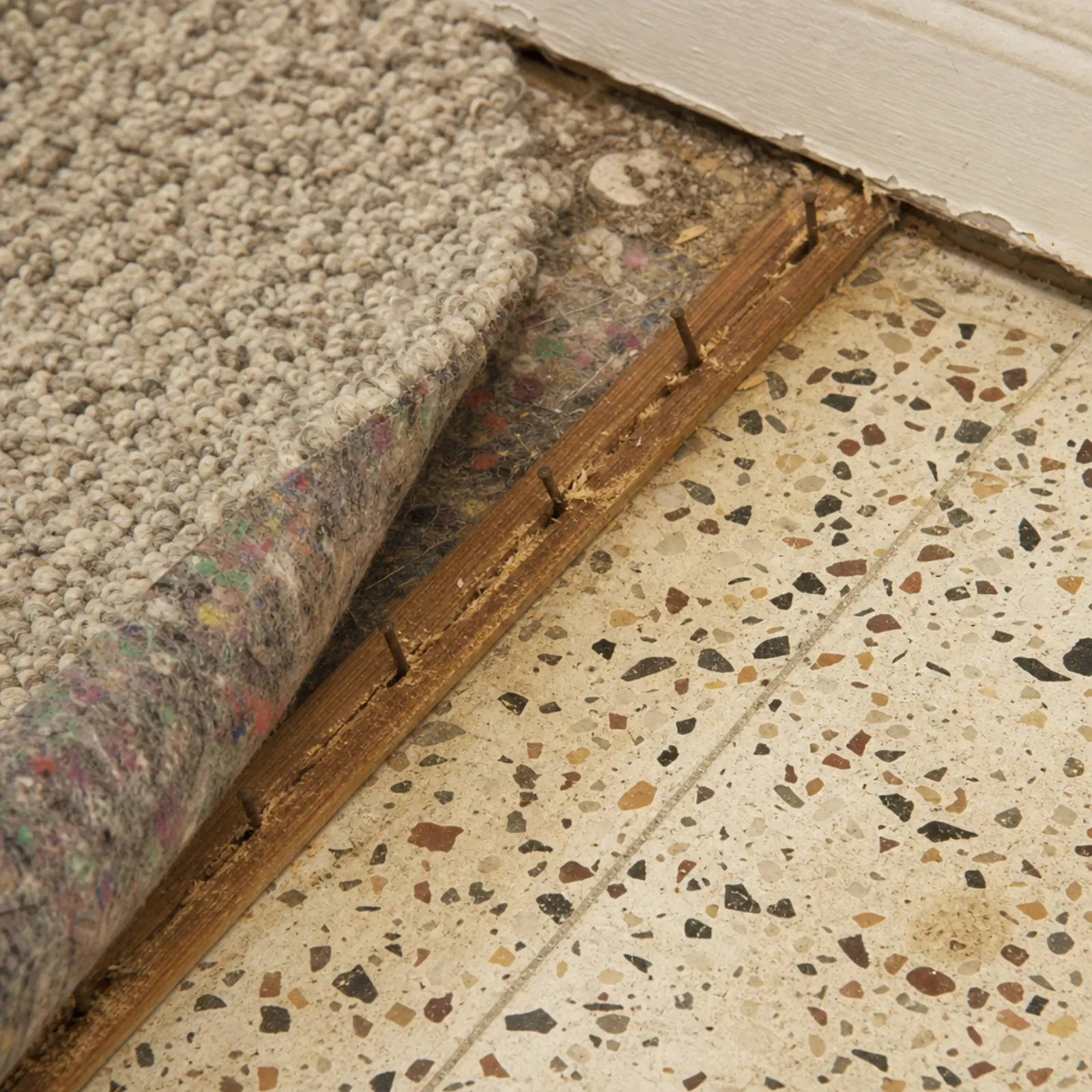
Terrazzo grinding and polishing in St. Petersburg runs $4 to $8 per square foot and is the diamond-abrasion process that turns a dull, glue-scarred, or coated mid-century floor back into polished stone: metal-bond diamonds to flatten and strip, resin-bond diamonds to hone and polish, a densifier to harden the cement, and a penetrating sealer to finish. Nothing is painted on. If a floor is already exposed and just needs to shine again, this is the whole job; if it is under carpet or tile, it is the middle of the full restoration.
Why grinding, not coating
Cement terrazzo is marble chips in a Portland cement matrix, ground flat when the house was built. The shine you remember from a 1960 kitchen came from the polished marble, not from anything applied to it. When the floor went under carpet in the 1980s, the surface stayed but picked up glue, nail holes, rust, and dye. Decades of “terrazzo shine” products, acrylic floor finish, and paste wax on the exposed floors of the same era produced the yellowed, peeling floors that give the material a bad name.
The National Terrazzo and Mosaic Association’s sealer reference guide lays out three ways to protect terrazzo: permanent film-forming coatings such as urethane or epoxy, removable film-forming coatings such as acrylic “floor finish,” and honing and polishing combined with a silicate-based penetrating sealer, which it calls densification. In the third routine, the guide says, there is no sacrificial coating: the upper layers of the terrazzo are abraded away with successively finer grits until the floor is glossy, and any later scratch is fixed by re-honing rather than stripping and recoating. That third routine is what this page describes, because it is the only one that suits a sixty-year-old residential floor on a damp Pinellas slab. Films trap vapor; honed stone breathes.
The tooling and the grits
Metal-bond diamonds, 30/40 to 80 grit. Diamond segments sintered into a metal matrix, run on a planetary grinder that spins three or four heads while the whole head rotates. This is what cuts. Carpet mastic, cutback adhesive from old vinyl, an acrylic coating, rust rings, and the tired top layer of matrix all come off in the metal-bond passes. The floor is also flattened here; a mid-century floor ground by hand with a rotary machine often has slight waves and low spots at the divider strips, and the planetary head levels them. The GSA’s terrazzo repair specification calls for conventional terrazzo grinding equipment “rather than lighter type machines” and for wet grinding throughout, and that is the right instinct: a swing buffer with a sanding screen cannot flatten a floor or remove a coating, and a lot of bad terrazzo work in this county was done with one.
Grout pass. After the coarse grinding the surface has tiny voids where chips popped or pinholes opened in the matrix. The NTMA restoration specification calls for wet grinding at 50 grit or higher, then machine or hand grouting with cement or epoxy tinted to the matrix, cured a minimum of 12 hours at 70 to 80 degrees. The grout is then ground off the surface so it stays only in the voids.
Resin-bond diamonds, 100 to 3000 grit. Diamonds in a phenolic resin, softer than metal bond, which polish rather than cut. Passes at 100, 200, 400, and 800 close the surface; 1500 and 3000 bring it to a mirror. The NTMA specification lists a final pass with 120-grit carborundum or 200-grit resin-bond diamond as the point where the grout has been removed and the floor is ready for sealing in a commercial restoration, and its finish guidance describes residential and commercial finishes ranging from a standard 120-grit finish up to 1500 grit or more with diamond-impregnated pads. Where you stop is your call.
Densifier. A lithium or sodium silicate applied around the 200 to 400 grit stage reacts with the free lime in the cement matrix to form harder calcium silicate. The NTMA sealer guide notes that densifying freshly polished terrazzo reduces porosity and helps repel liquid stains. It also lets the matrix take a higher polish instead of just the chips.
Penetrating sealer. The final step. The NTMA says a penetrating sealer is applied to cement terrazzo for improved resistance to stains, dirt, and wear. It goes into the pores rather than sitting on top, so the floor does not get a film that can yellow or peel. The sealing page covers renewal and care.
Choosing a sheen
| Finish | Grit stop | Look | Best for |
|---|---|---|---|
| Matte | 200 to 400 | Flat, stone-like, hides scuffs | High-traffic rooms, rentals, 1950s small-chip gray floors |
| Satin | 800 | Soft glow, period-correct | Most whole-house jobs |
| High gloss | 1500 to 3000 | Mirror | Showpiece floors, larger-chip 1960s patterns |
Each level past 400 grit is more time on the floor, which is why gloss sits at the top of the $4 to $8 range. Matte and satin are also easier to maintain and easier to touch up.
What the floor looks like in St. Petersburg
The chip and matrix combinations run by decade and by builder. The 1950s block ranches of Disston Heights, Meadowlawn, and the streets around Jungle Prada tend toward small white and gray chips in a gray or white matrix, which close up fast under the resin passes. The later 1960s houses, including the Rutenberg-era homes the University of Florida’s postwar housing survey documents in Pinellas Point, bring larger chips and more color: tan, pink, green, and black marble, sometimes with a different color in each strip-bounded panel at the entry. Larger chips need more passes to bring the matrix and the chips to the same level of polish, and colored matrix shows every leftover pinhole, so those floors run higher in the range.
Divider strips are ground along with everything else. The GSA specification cautions crews to exercise care when grinding near coated divider strips, and on a mid-century floor the brass or zinc strips come up bright at the same time the stone does, which is one of the best moments of the job.
What grinding fixes and what it does not
Fixes: glue, dullness, scratches, light staining, old coatings, unevenness at the strips, rust rings, carpet dye, and the gray cast of sixty years of dirt worked into the matrix. Does not fix: holes and cracks, which are patched first on the repair page; deep stains that go below the depth of the grind, which the NTMA warns may not be removable and which the stain page addresses with poultices; and active slab movement.
Grinding removes very little material, typically well under a sixteenth of an inch on a topping that was poured half an inch to three-quarters of an inch thick, so a floor can be restored more than once in its life. The tell for a floor that has been over-ground before is divider strip standing proud of the surface, and it is worth checking for.
Getting a number
Send a photo of the exposed floor, a close-up of the worst spot with a coin for scale, and the square footage. The range from the pricing page comes back fast. The service covers St. Petersburg and the county: Gulfport, Pinellas Park, Seminole, Largo, Clearwater, and Dunedin.
Frequently Asked Questions
What is the difference between grinding and polishing?
Grinding is the coarse work: metal-bond diamond segments around 30/40 to 80 grit that flatten the floor and cut off glue, stains, coatings, and the worn surface. Polishing is the fine work: resin-bond diamonds from 100 grit up to 3000 that close the surface until it reflects light. Both are abrasion; neither adds anything to the floor.
How much does terrazzo polishing cost in St. Petersburg?
Grind and polish is $4 to $8 per square foot. A floor that was only ever carpeted with light glue and a satin finish is near $4. Heavy mastic, an old acrylic coating to grind off, large-chip terrazzo, or a 3000-grit high gloss pushes toward $8. Removal, patches, and stain treatments are separate line items.
Can I choose how shiny the floor is?
Yes. Matte stops around 200 to 400 grit, satin around 800, and high gloss runs to 1500 or 3000. The NTMA describes terrazzo finishes ranging from a standard 120-grit finish to 1500 grit or more with diamond-impregnated pads. Many owners of 1950s gray-chip floors choose satin because it hides scuffs and looks period-correct.
Why not just use a terrazzo shine product?
Because it is a film sitting on top of a dirty floor, and it fails. The NTMA warns that wax coats the surface, can yellow and dull, wears quickly, and makes the floor slippery. Diamond polishing puts the shine in the stone, so it does not peel and it can be re-honed if it ever scratches.
Is the process dusty?
Grinding is done wet with vacuum shrouds on the machines, so the slurry is contained and vacuumed rather than becoming airborne dust. There is still cleanup and some mess, and our crew masks off adjoining rooms. Rooms are done in phases so you can stay in the house.
More terrazzo services
Areas we serve
- St. Petersburg, FL
- Terrazzo Restoration in Belleair, Florida
- Terrazzo Restoration in Clearwater, Florida
- Terrazzo Restoration in Dunedin, Florida
- Terrazzo Restoration in Gulfport, Florida
- Terrazzo Restoration in Kenneth City, Florida
- Terrazzo Restoration in Largo, Florida
- Terrazzo Restoration in Pinellas Park, Florida
- Terrazzo Restoration in Safety Harbor, Florida
- Terrazzo Restoration in Seminole, Florida
- Terrazzo Restoration in St. Pete Beach, Florida
- Terrazzo Restoration in Treasure Island, Florida